
In Florence, every stone, every palace, and every flavor carries a centuries-old history.
At Antica Torre Tornabuoni, preserving and celebrating this heritage is not just a privilege — it is an integral part of our identity. Living in a medieval tower transformed into an exceptional residence means embracing the memory of the city, and part of this memory is expressed through its traditional gastronomy.
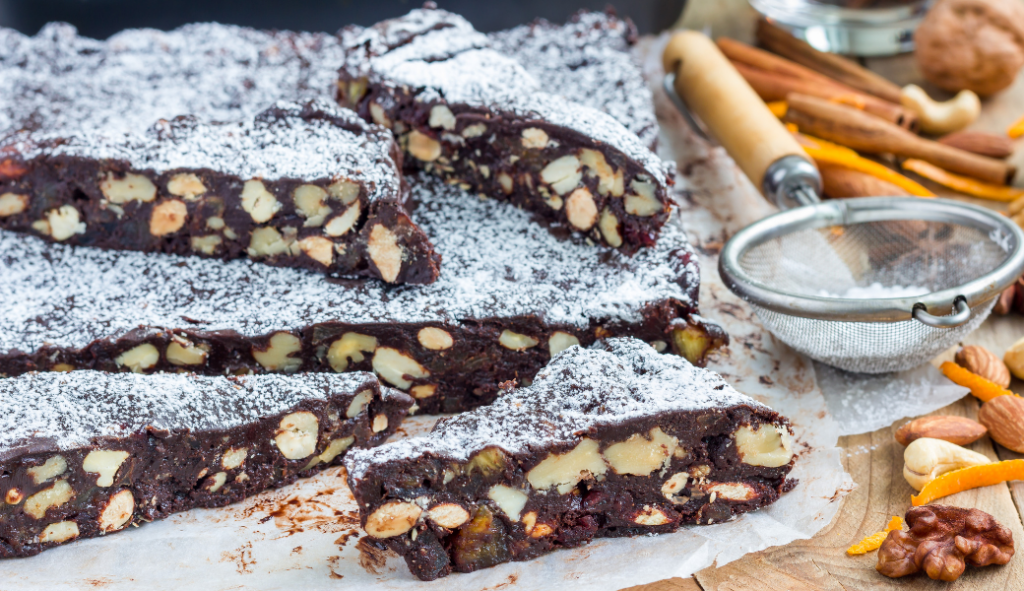
Among the sweets that best represent Tuscan culture, especially during the Christmas season, panforte undoubtedly stands out — a specialty with medieval origins that still enchants today with its rich aromas and sensations.
A medieval origin: when panforte was a precious gift
Panforte was born in Siena, but it has become a symbol of all Tuscany.
Already documented in the 13th century, it was prepared in monasteries and city ovens as a sort of “reinforced bread,” enriched with honey, spices, and nuts — ingredients that were extremely precious at the time, often imported from afar.
This dessert was reserved for nobles, knights, important pilgrims, and even high-ranking clergy. Not surprisingly, some legends tell that it was offered as a gift during official visits or special occasions.
Its spices — cinnamon, nutmeg, pepper, cloves — not only made it unique, but also testified to Florence and Siena as crossroads of trade and encounters between cultures.
Panforte today: a ritual that smells like Christmas
Today, panforte is one of the most beloved symbols of the Tuscan Christmas season.
Every family has its favorite recipe, and every slice seems to carry a story: the holidays of the past, winter markets, festive tables that bring generations together.
Two versions are the most famous:
Panforte Margherita, more delicate, created in 1879 in honor of Queen Margherita of Savoy.
Panpepato, the older version, with a bold and intense aroma due to stronger spices.
Regardless of the variation, panforte remains a living link to the past. Tasting it means connecting with an authentic tradition that does not fade with time.
The value of tradition for Antica Torre Tornabuoni
At Antica Torre Tornabuoni, we believe that true hospitality is born from the ability to preserve and share the roots of the territory. Florence is not only art and architecture: it is also a culture of living, savoring, and celebrating both small and great traditions.
Sharing the story of panforte with our guests means opening a door to the most authentic Tuscany, to that intimate dimension that often remains hidden behind monuments and museums.
For us, keeping this memory alive is not an act of nostalgia, but a way to make every stay more meaningful.
Every story, every recipe, and every symbol of our territory is part of who we are and what we wish to transmit.
Would you like to bring a little of this magic into your home? Here is our traditional recipe.
PANFORTE
Ingredients for a 20 cm pan:
- Unpeeled almonds: 260 g
- Candied citron cubes: 160 g
- Candied orange cubes: 160 g
- Sugar: 300 g
- Honey: 150 g
- All-purpose flour: 160 g
- Nutmeg: 0.4 g
- Ground cloves: 0.4 g
- Ground coriander: 0.4 g
- Ground cinnamon: 2 g
- Powdered sugar: 10 g
- Wafer paper: 1 sheet
To dust the surface
- Powdered sugar, as needed
Preparation:
- Place the sugar and honey in a small saucepan and heat, stirring until dissolved.
- Transfer the mixture into a Pyrex bowl.
- Add the candied citron, candied orange, and almonds.
- Mix everything together, then incorporate the flour, continuing to stir with a spoon. Don’t worry if the dough becomes very stiff — that’s normal.
- Add the cinnamon, finely ground cloves, coriander, and nutmeg.
- Mix again — using your hands if easier — until all ingredients are well combined; the mixture will need to be worked quite vigorously.
- Butter a 20 cm springform pan and place the wafer paper sheet on the bottom.
- Cut a strip of parchment paper the height of the pan and long enough to line the entire circumference; use it to line the sides of the pan.
- Transfer the mixture into the pan, then dip a spoon into a small bowl of water and use the back of the spoon to level the surface, wetting it as needed. Wetting the spoon helps press and evenly distribute the mixture across the pan.
- Dust the panforte with about 10 g of powdered sugar until fully covered. Bake in a preheated static oven at 220°C for about 10 minutes. After this time, remove the panforte from the oven and let it cool for just a few minutes — not completely — otherwise it will be difficult to unmold.
- Unmold the panforte, remove the parchment paper, and dust again with powdered sugar before serving.
Storage:
Keep the panforte under a glass dome at room temperature for up to 4 days.
Tip:
Do not let the panforte cool completely in the pan, or unmolding it may be difficult. You can replace part of the almonds with hazelnuts and use other types of candied fruit.
Experience Florence through its flavors
During the Christmas season, Florence fills with the scent of spices and toasted almonds. Strolling through historic shops and traditional pastry stores, it is not unusual to come across artisanal panforte prepared according to recipes passed down for generations.
We always encourage our guests to try it: it is a simple and delicious way to tune into the cultural rhythm of the city.
And when you return to the quiet and elegance of Antica Torre Tornabuoni, the taste of panforte seems to blend perfectly with the sensation of living — even just for a few days — within history.