
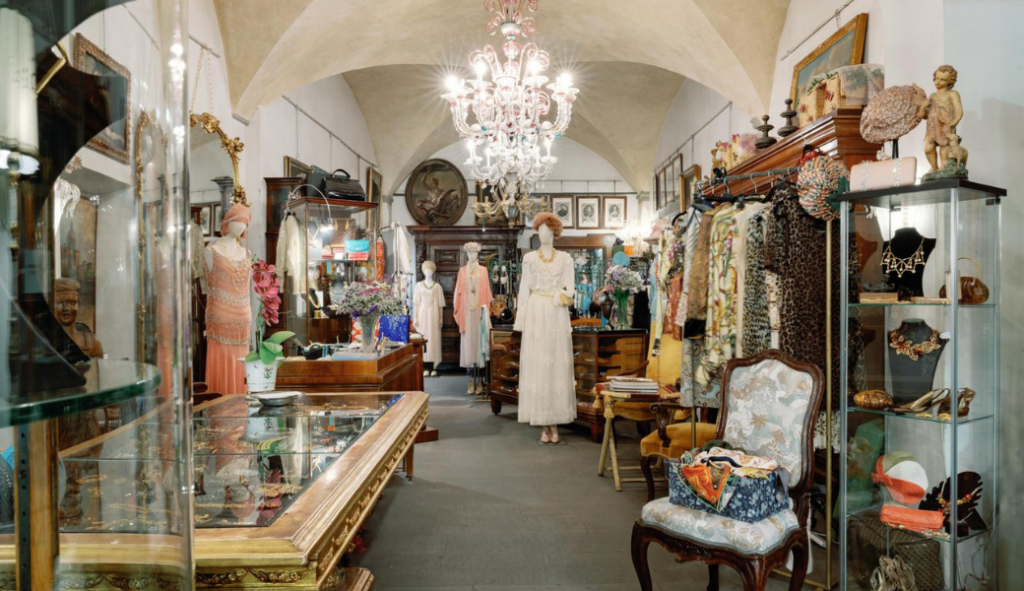
Walking through the streets of Florence always means discovering new shades of beauty, art, and history. On one of the streets in the city center, a discreet façade sparks curiosity. Once you cross the threshold, it feels as though a portal to the past opens up. Clothes, bijoux, shoes… an endless array of objects that carry with them memories of parties, journeys, nights of love. And, with them, a different kind of energy, as if they had a soul.
“An object is interesting because it has its own soul, its own uniqueness. In fact, even our clients say that here they can feel the soul of the garments,” says Beatrice Albrici, owner of ReCollection. The third generation of a family of antique dealers, she brought her vintage collection to Florence. We discover its details in the interview that follows.
Beatrice, how was ReCollection born, and what was the initial spark that led you to create this project?
The story is very long, because we celebrated our 100th anniversary precisely in 2025. It all began with my grandfather in 1925, with the collecting— as was done at the time— of scrap iron and old objects. Then he opened the first shop, and later a second one. There was the period of the war, during which my father was a teenage boy. After the war, he too devoted himself to antiques.
Many antique dealers came to Brescia, including Florentine ones, because 16th- and 17th-century Brescian furniture resembles Florentine and Sienese furniture. My grandfather became friends with two antique dealers, Scipione Coppini and Maria Suonatori, who became a widow during the Second World War. For this reason, she asked my grandfather to send my father or my uncle— very young at the time— to bring anything at all to sell, because in the postwar period Americans were interested in antiques. My grandfather loaded chests of drawers, chest benches, everything.
When my father was 18, Maria Suonatori fell ill, and since she was alone, he stayed in Florence for an entire year to help her, becoming friends with various antique dealers. Eventually, she asked my father and my grandfather to take over the shop. My father identified Giovanni Paderni, a restorer friend, as the right person and told him to go to Florence.
Meanwhile, I had a shop in Brescia and one in Milan, and I was already working in the sector of antique lace. Then, about 18 years ago, my current partner, who is an antique dealer, took over a Milanese house belonging to a count and countess with no children. I bought 183 evening dresses, plus accessories. I’ve been selling these things for years. Some of them ended up in charity exhibitions, in theaters, and in golf clubs. It was a huge purchase.
Then we arrived in Florence: almost twenty years ago Giovanni Paderni fell ill. The shop was left without a leader, and my father told me, “you must go to Florence.” I obeyed, and today I’m here.
I brought with me what I had, and it was an incredible growth. It was the right moment for vintage, I was loaded with beautiful things, and the public was more than ready. Today there is what you see: an agglomeration that maintains the face of antique dealing from the past, for today.
ReCollection works with vintage pieces selected with great care. How does this selection take place?
I am the one who buys the pieces, and I must be grateful for my training as an antique dealer, because sometimes I see videos by many highly respectable vintage merchants, but without an antiquarian background. And this makes a difference, in the sense that we do not pursue Chanel because it is Chanel, or Hermès because it is Hermès. First, the object must be rare, beautiful, and interesting, and only then is the signature or tailoring welcome.
This taste for what is precious, particular, and rare, in my opinion, is deeply rooted in a background that comes from three generations.
But do you actually do research? How does it work?
In this, you need luck: there’s the lady who calls me right from Florence with beautiful garments. But the fun part is really my research. I go to France three or four times a year, or to London, or through contacts, and that’s where I find the most extravagant pieces that I bring back.
Especially when it comes to antique items related to lingerie, lace, and matinées: in France there was greater wealth, a much broader panorama of nobility. Cities like Paris, Bordeaux, or Lyon, for everything related to the 19th century and Art Nouveau, have much more than Italy. We’re talking about dresses, hats, theaters: they lived more bohemian lives than those that could be lived in Italy, so there is much more material. And it’s a delight.
Has it ever happened that you found something unexpected in a place you didn’t imagine?
Yes, look, and not only when talking about vintage: in my opinion there are certain combinations, certain special attractions. The most overwhelming thing that happened to me concerns Marie Antoinette, whom I’ve been passionate about since I was a young girl. I have tons of books, even antique ones.
One day I was at the flea market in Paris. We had been there since 7 in the morning, it was 2 p.m. and we were leaving. In a not-so-nice area I saw an alley, turned my head, and saw a little stall at the end: something told me I had to go there. On this stall there was a bundle with the last letters of Marie Antoinette to her children before she died. Letters from the 19th century to the two children she was leaving, knowing she would be guillotined a few hours later, and to her 15–16-year-old sister. I tell you, I cried. I read some of them during lockdown, but I had to stop because I was feeling too unwell.
But what I mean is that sometimes there are things that call me, and I always find something special. Another time, in New York, when I was 20, I bought a miniature on silver depicting Cardinal Albani. When I returned, we published an advertisement and a scholar wrote to me asking for detailed photos. He discovered it was by Goya. He explained to me that Goya hid his signatures under varnish. A few years later he sent us all the documentation.
This is to say that you carry with you, even without wanting to, eyes older than you. By constantly seeing beautiful things, you acquire a sensitivity, not only for objects but also for clients. If someone does not understand what they are buying, I do not sell. It’s more than a simple sale: we create a feeling that gives meaning to coming into the shop and to working until you are 90 years old, as my father does. Because it’s beautiful, because it gives you joy, because it has meaning. Otherwise it’s just buying and selling.
The way you describe the choice of garments makes it seem as if they have a soul, a personality. Is that so?
It’s true. Once many garments arrived in the shop, and it felt like an army of women entering here, because their taste was very identifiable. Even garments I wouldn’t have chosen, but I could feel the women’s energy. When you sell me a garment, a part of you comes with it. In fact, even clients say that here you can feel the soul of the garments.
Let’s talk a bit about sustainability. Today, as we know, there are all these chains with “disposable” items, and here you greatly enhance garments and reuse.
I think this is what gave the big boost to vintage, also thanks to foreigners. Very young girls, even 14 years old, very concerned about sustainability, who choose vintage precisely for this reason.
In fact, we try to avoid fabrics with less durability: here everything is wool, silk, linen. This has been a very important channel for vintage, especially regarding the sustainability of materials. Then reuse is fundamental. I’ve had elderly people give me their things knowing they would go around the world. They didn’t want them to end; they wanted them to have a new life.
And it’s very beautiful to know that a garment that no longer fits you, or that you no longer have the age to wear, will be worn by another girl who will take it around the world. It must also be said that fashion in the past was not as dizzying as it is today. Clothes were not thrown away: we used them until they fit us, and then maybe they were passed on to a sister. This “disposable” mindset, I see, especially the more sensitive girls don’t want it.
Sometimes something looks beautiful, then you touch it and you understand that it really isn’t. Beyond the material, there is a poverty of creativity, because by now everything is copied. An object is interesting because it has its soul, its uniqueness.
We also see this in the world of brides: there are brides who choose the dress already thinking about what to do with it afterward, something that can be used for the ceremony but also later on. Or changes are studied to transform it into a cocktail dress. You can recover a great deal even from an out-of-fashion dress. When you find beautiful fabrics, you can’t discard them just because the shape is no longer in use.
Then there is the whole world of designers, which has been very important also in my training. Especially those who have worked with major brands like Dior, Valentino, Armani: they have the eye of someone who has handled very beautiful things. Watching them work opens your eyes. Something I put on the head they used for a shoulder piece, something straight they turned upside down. Good designers have given a great deal to vintage. They gave the value of the idea. They fish out the idea: maybe you dismantle a beautiful jacket, a beautiful lace, a beautiful flower, you destroy it, but to create something new. And this is the great value.
Both Antica Torre Tornabuoni and ReCollection work on the idea of enhancing the past by making it contemporary. In your opinion, what are the points of contact between a historic residence and a vintage shop?
I really like the fact that you also offer a certain kind of experience. It’s not just work for the sake of work: there are values we care about, that we like to remain and to be perceived. Florence has Via Tornabuoni with the most famous brands in the world, but just turn the corner and you find a niche shop, still a bit of craftsmanship, some regional markets.
And then there are hotels like yours, where you live an emotion, where you want to remain tied to the memory of that week in Florence, a memory that stays in your heart. We are strongly connected by a non-trivial way of working. Not because we necessarily want to leave a mark on people, but because we have love for a certain way of working that is part of us. And I think this is what unites us.
One last question: for those who have not yet entered the world of vintage but want to change their approach and move away from “disposable” fashion, what advice would you give?
It is certainly a great saving; you always make a good deal. With vintage, even if you find an expensive piece, a Hermès or a Chanel, it’s never like going into a boutique, and that alone is convincing. Then they increase in value. Historic garments go up in price. There are many tailored pieces, things designed to last over time, even through changes in your own shape.
If someone is really careful, looks closely, they come out with real bargains. You need to look calmly, at each garment. If you decide to dedicate a morning to searching, you will see that you find the price you want, the quality you want, what fits you, and you really make an excellent deal.