
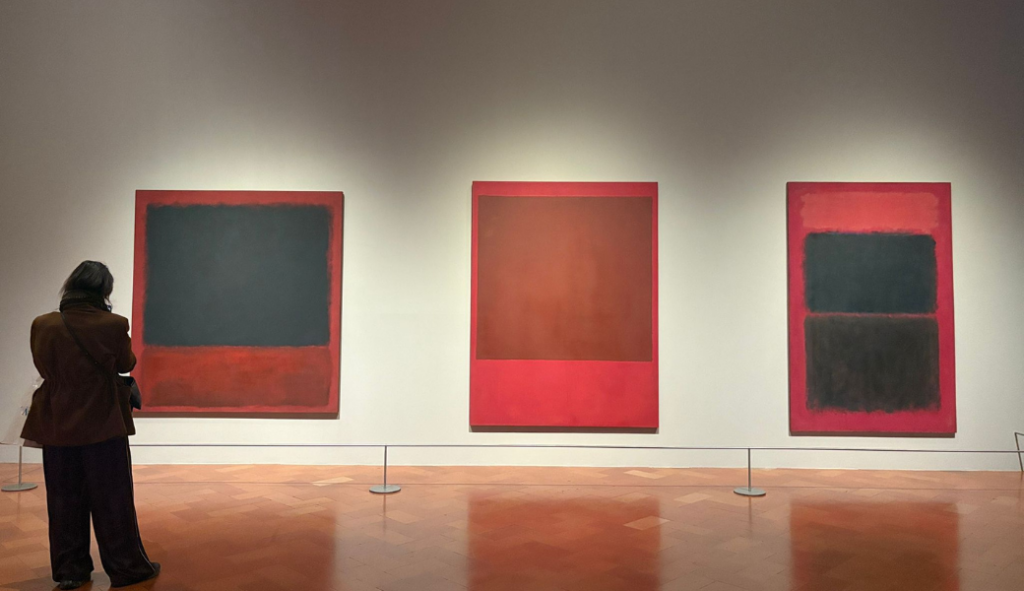
From March 14 to August 23, 2026, Fondazione Palazzo Strozzi presents one of the most important exhibitions ever dedicated to Mark Rothko, a leading figure of American modern art. Titled “Rothko in Florence,” the exhibition explores the deep connection between the artist and the city, placing his work in dialogue with the great tradition of the Renaissance.
Curated by Christopher Rothko and Elena Geuna, the exhibition was conceived specifically for Florence. The Renaissance architecture of Palazzo Strozzi provides an ideal setting to understand one of the most fascinating aspects of Rothko’s artistic research: the tension between classical balance and expressive freedom. Through this dialogue, color becomes more than a visual element — it transforms into an emotional space capable of transcending the two-dimensional surface of the canvas.
The exhibition brings together more than 70 works, many of which have never before been shown in Italy. These pieces come from prestigious private collections and leading international museums, including Museum of Modern Art, Metropolitan Museum of Art, Tate, Centre Pompidou and National Gallery of Art. Among the highlights are monumental canvases such as No. 3 / No. 13 (1949) from the MoMA and Untitled (1952–1953) from the Guggenheim Museum Bilbao.
The exhibition at Palazzo Strozzi follows a chronological path, allowing visitors to trace the artist’s entire career. The first rooms focus on the 1930s and 1940s, when Rothko was still experimenting with figurative painting influenced by Expressionism and Surrealism.
Over time, his research gradually moved toward abstraction, culminating in the iconic works of the 1950s and 1960s: vast overlapping fields of color suspended in space, capable of immersing the viewer in a deeply contemplative and almost meditative experience.
Florence and the inspiration of the Renaissance
The exhibition extends beyond the walls of Palazzo Strozzi and into the city itself, involving two places that held particular significance for Rothko. The artist first visited Florence in 1950 during a trip to Italy with his wife Mell. He was profoundly moved by Renaissance art and architecture, which left a lasting impression on his artistic vision.
One of the most evocative stops is Museo di San Marco, where several works by Rothko are placed in dialogue with the frescoes of Fra Angelico in the famous monastic cells. This juxtaposition reveals surprising affinities. The silent spirituality of the Dominican friar’s paintings resonates with Rothko’s chromatic surfaces, where color becomes a vehicle for contemplation.
A second group of works is displayed in the striking vestibule of the Biblioteca Medicea Laurenziana, an architectural masterpiece designed by Michelangelo. Within this extraordinary space, Rothko’s paintings engage in a powerful dialogue with the lines and proportions of Renaissance architecture, creating a unique visual experience for visitors.
The life and artistic vision of Mark Rothko
Mark Rothko was born in 1903 in Dvinsk, then part of the Russian Empire (today Daugavpils in Latvia), under the name Marcus Rothkowitz. At the age of ten he emigrated to the United States with his mother and sister to join his father and brothers in Portland, Oregon.
After studying at Yale University between 1921 and 1923, he moved to New York, where he began to devote himself fully to painting. In the 1930s he taught at the Brooklyn Jewish Center and founded the artist group The Ten, which promoted a modern art independent from academic traditions. His early works show a strong interest in Greek mythology, primitive art and psychoanalysis, often influenced by Surrealism and automatic drawing techniques.
By the late 1940s, however, Rothko made a decisive breakthrough: he abandoned figurative imagery to develop the pictorial language that would make him famous. His monumental canvases, defined by large floating fields of color, do not represent objects or figures. Instead, they seek to evoke universal human emotions such as solitude, silence and transcendence.
For Rothko, painting was never merely decorative — it was a profoundly spiritual experience. Among the key moments of his career were his participation in the Venice Biennale in 1958 and the commission for the Four Seasons Restaurant in the Seagram Building in New York, a project he later famously abandoned.
In the 1960s he worked on the monumental paintings created for the Rothko Chapel, a contemplative space that today houses fourteen of his works. Mark Rothko died in New York in 1970 after a long illness, leaving an artistic legacy that continues to profoundly influence the history of contemporary art.
An experience to discover in Florence
The exhibition “Rothko in Florence” offers an extraordinary opportunity to discover the work of one of the most important artists of the twentieth century while exploring an unexpected dialogue between modern art and the Renaissance.
Moving between the halls of Palazzo Strozzi and the historic sites that inspired the artist, visitors are invited to experience a journey across centuries of art history — demonstrating how, in Florence, the past continues to inspire new creative visions.