
Florence is home to many places that seem to challenge time itself and preserve the city’s history, but few are as evocative as the Basilica of San Miniato al Monte, which has recently undergone an important restoration project capable of enhancing its grandeur even further.
Located at one of the highest points of the city, with a privileged view over Florence, the church is considered one of the finest examples of Romanesque architecture in Tuscany.
More than a simple technical intervention, the project represented a careful effort of historical, artistic, and architectural preservation.
A transparent and accessible restoration
Throughout the entire restoration process, the Basilica remained open to the public thanks to a worksite designed to be transparent and accessible. Guided tours allowed visitors to closely follow the different phases of the restoration, transforming the process itself into an opportunity for cultural discovery.
The initiative reinforces an increasingly widespread idea in Italy: restoring a historic heritage site should not mean temporarily hiding it from the public, but rather creating new forms of dialogue between people, art, architecture, and history.
The delicate restoration of the façade
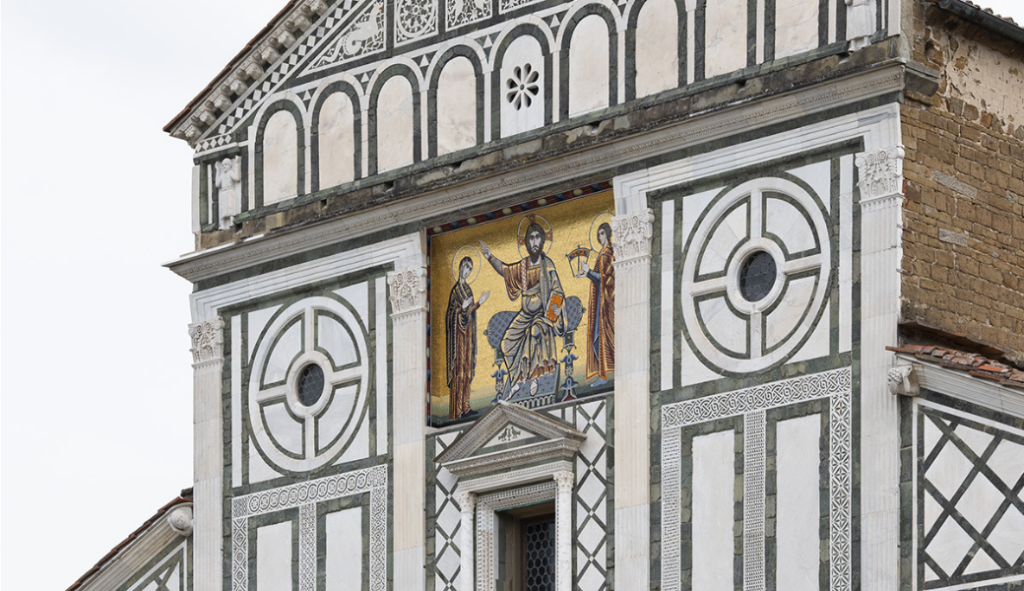
Much of the intervention focused on the Basilica’s iconic white and green marble façade.
The works included delicate cleaning operations, treatments against biological agents, surface consolidation, and the restoration of sculptural elements, mosaics, and decorative marble inlays.
The goal was not to “modernize” the church, but to preserve its authenticity and restore clarity to the architectural details that make San Miniato one of Florence’s artistic symbols.
In addition to the aesthetic restoration, protective treatments were also applied to ensure greater durability for the restored surfaces.
Medieval structures and contemporary engineering
The works also revealed significant structural issues. During the roof inspections, problems were identified in some of the ancient wooden trusses supporting the structure.
In certain areas, there was a risk of progressive deformation caused by the deterioration of structural joints.
The chosen solution sought to respect the Basilica’s original construction logic: discreet burnished steel supports were installed to reinforce stability without visually altering the historic structure.
Seismic improvements and masonry consolidation works were also carried out, particularly near the bell tower.
The bell tower and the marks of history
The imposing bell tower of the Basilica carries centuries of Florentine history.
Rebuilt in the 16th century on unstable ground, over time it caused structural movements affecting parts of the church walls and the crypt below.
According to historical accounts, it was atop this very bell tower that Michelangelo positioned cannons during the defense of Florence against the French siege.
Today, the restoration works contribute to preserving not only the stability of the structure, but also the historical memory it represents.
The restoration of the golden eagle
Another central element of the project was the restoration of the eagle placed at the top of the façade’s pediment.
The sculpture showed evident signs of deterioration, including metal oxidation, cracks, and detached decorative elements.
After being carefully removed, the sculpture underwent a meticulous restoration process in the laboratory, including the preservation of the original gilding and the application of anti-corrosion treatments.
A heritage that continues to live
Visiting San Miniato al Monte means understanding that Florence is not simply a museum-city. It is a place where the past continues to be preserved, studied, and lived every day.
The restoration of the Basilica demonstrates how tradition, technique, and conservation can coexist, allowing works of art and historic architecture to endure through the centuries without losing their essence.
And for those visiting Florence, few experiences are as special as admiring the city from the heights of San Miniato, surrounded by centuries of history, silence, and beauty.